If a plant kept on a house verandah begins to wither, its leaves turning yellow and falling off, what do we do? Do we yell at the plant? Do we ask it, ‘Why don’t you look lush and green like yesterday; why aren’t you behaving normally?’
No, we never do that. We bend down and examine the soil in the pot. We check whether there is a lack of water, whether the sunlight is too harsh, or whether the soil has lost its fertility and turned stony. We do not blame the plant; we change the environment around its roots.
Yet what an irony it is that when one of our loved ones, our child, or a family member struggles with inner mental turmoil, all the blame is placed squarely on their shoulders. It is society’s cruelest tragedy that instead of recognizing mental trauma as a genuine biological illness, it is dismissed as a person’s ‘weakness’, ‘tantrum’, or ‘character flaw’. If they suddenly lash out at someone, lock themselves in a room, disconnect completely from social interactions, or sit in numb silence—family members and neighbors get exasperated with them, pile on unsolicited advice, or even laugh at them. They are forcibly pressured to act ‘normal’—just as a person with a fractured leg might be forced to run.
Under the Microscope: Not Mere Melancholy, but a Burning Forest
If a depressed brain is observed under a powerful microscope, it reveals no abstract sadness. It looks like a burning, lush forest.
Just as hostile soil withers a plant, the blind rat-race of society, emotional trauma, and relentless chronic stress pour down upon the brain like acidic rain in the form of cortisol. Our brain is a delicate network of trillions of tiny wires (neurons). The chief executive in charge of decision-making and emotional regulation (Prefrontal Cortex) and the library that preserves memory and context (Hippocampus) are linked through these very wires.
When the toxicity of the environment escalates, this biological upheaval erupts within the brain:
- Attack by the Protectors (Internal Inflammation): The brain’s tiny custodial and defense cells (Microglia), overwhelmed by sustained stress, become hyperactive and begin releasing toxic inflammatory chemicals (pro-inflammatory cytokines).
- Drying up of Biological Fertilizer: The brain produces a vital natural protein—BDNF (Brain-Derived Neurotrophic Factor). This can be thought of as the brain’s ‘fertilizer’, essential for sprouting new wires and preserving existing connections. The onslaught of chronic stress shuts down the production of this fertilizer.
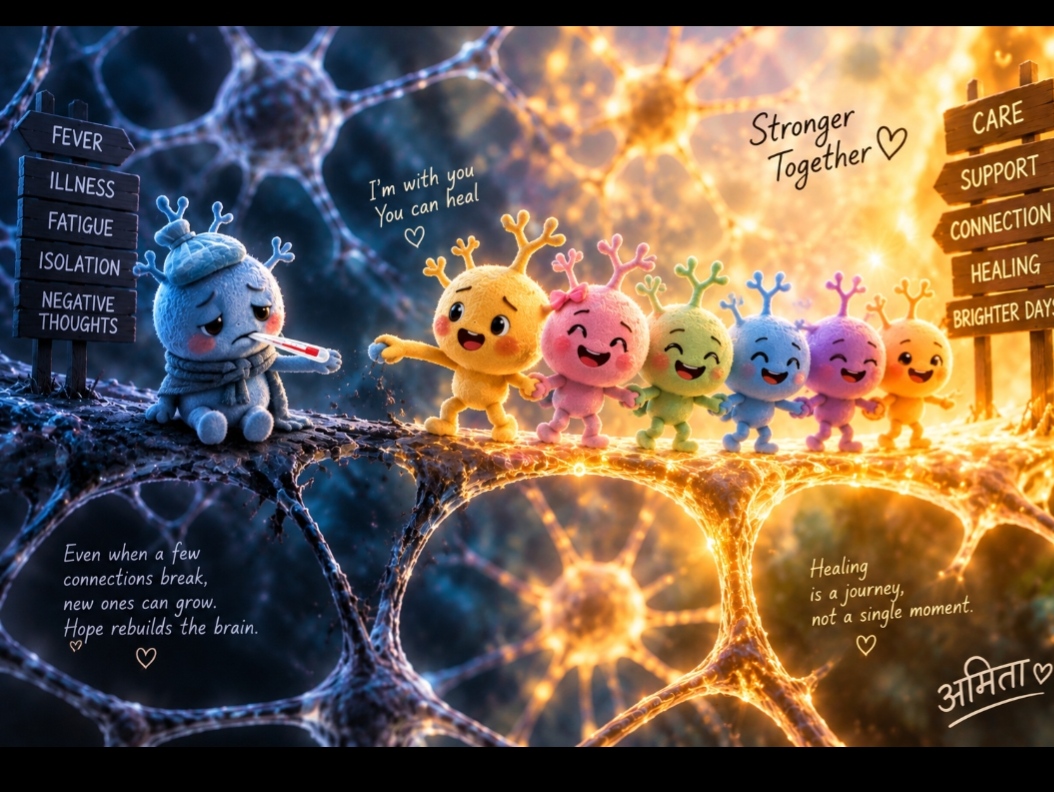
- The Unraveling of the Wires: Deprived of fertilizer and battered by inflammation, the tiny finger-like projections at the tips of neurons (Dendritic Spines) shrivel, wither, and retract. They let go of each other’s hands.
When these wires break, the transmission of chemical and electrical signals comes to a grinding halt. Someone becoming withdrawn, suddenly aggressive, or detaching from the world is not putting on an act—it is the silent scream of these severed circuits.
The Paradox: Successful Professional vs. Innocent Child
The argument is often made that deprivation alone causes sorrow. But if that were true, why is that 45-year-old corporate leader trapped in the deep abyss of depression—a person blessed with enormous wealth, prestige, status, and luxury? And if ambition alone is the culprit, why is that 16-year-old innocent child suffocating, having barely stepped into the struggles of life?
This proves that depression does not stem from external achievements or external lack; it is born from the breakdown of the nervous system.
- The high-achiever lives round the clock in a state of invisible hyper-vigilance and behind the exhausting facade of emotional performance, where their cortisol levels never decline.
- Meanwhile, the teenager’s still-developing brain is crushed under the relentless social comparisons of the digital world, the inhumane pressure of examinations, and the terror of rejection.
In both instances, the soil has turned toxic, and the neural wiring of both brains is burning in the exact same manner.
The Myth: Is Depression Merely a Chemical Deficiency?
For decades, the world was taught that depression is simply an imbalance of neurotransmitters like serotonin or dopamine, solvable by popping a few pills (antidepressants). However, landmark research (such as the STAR*D trial in the United States) demonstrated that roughly one-third of individuals do not respond to multiple courses of conventional medication.
Psychiatrist Dr. Tracey Marks offers an apt metaphor: It is just like having a deep wound that is actively bleeding. Traditional medications were focused on replenishing the lost blood (raising chemical levels), but nobody was attempting to close the open wound that was causing the bleeding in the first place. Low serotonin is an outcome, a consequence of severed circuits, not the root cause. True healing lies in repairing and reconnecting that broken circuitry.
Evidence from Indian Laboratories: Stem Cells and Mini-Brains
This is no longer mere theory or clinical conjecture. In India, supported by Rohini Nilekani Philanthropies, scientists at the Centre for Brain and Mind (CBM)—a collaboration between NIMHANS, NCBS (National Centre for Biological Sciences), and inStem—have conducted pioneering research.
Using stem-cell technology (iPSCs), researchers took small blood samples from individuals coping with severe mental health conditions and grew living human brain cells (Neural Organoids, or mini-brains) inside the laboratory. Through this, scientists witnessed firsthand under laboratory observation how stressed neural cells lose their path, how their migration falters, and how their connections disintegrate. This research conclusively affirmed that while our genetics may determine vulnerability, it is our environment, emotional climate, and relationships that hold the ultimate switch.
The Road to Recovery: The Rebirth of Broken Circuits (Neuroplasticity)
The most groundbreaking and hopeful revelation of modern neuroscience is Neuroplasticity. Donald Hebb’s foundational rule states: “Neurons that fire together, wire together.” The brain is not a rigid slab of concrete; it is living, moldable soil. Given the right nourishment, safe surroundings, and intentional habits, severed neural wires can sprout anew.
Scientific and practical ways to rewire this biological network include:
- Changing the Soil of the Pot (Environment & Compassionate Dialogue): Stop blaming the individual. Cultivate an atmosphere of unconditional acceptance at home and in community spaces. When a person feels genuinely heard, safe, and understood without judgment, the nervous system releases oxytocin, one of nature’s most potent antidotes to internal neuro-inflammation.
- Mindfulness and Meditation (Repairing Consciousness): Harvard fMRI studies have demonstrated that regular mindfulness, breathwork, and meditation quiet the hyperactivity of the brain’s fear center (Amygdala) and physically increase gray matter density in the prefrontal cortex. Meditation is not just a calming exercise; it is an active physical rewiring of the brain.
- Creative Pursuits and Hobbies as Medicine: Gardening, painting, sculpting with clay, music, or writing—when an individual immerses themselves in a genuine creative interest, the brain shifts out of ‘fight-or-flight’ mode and enters ‘rest-and-repair’ mode. Creativity builds fresh biochemical bridges across disrupted neural pathways.
- Physical Movement (Aerobic Exercise): A brisk 30-to-40-minute daily walk, swimming, or sports directly upregulates BDNF (the brain’s fertilizer). It serves as a natural catalyst for neurogenesis—the birth of brand-new neurons inside the hippocampus.
Conclusion
The next time a loved one, a child, or a colleague breaks down under the weight of life, behaves erratically, withdraws into silence, or becomes irritable—do not snap at them. Do not mock them.
Remember, they are like that potted plant whose soil has parched and whose internal forest of wires is burning. They do not need sharp lectures or forced cheerfulness; they need your presence, patience, understanding, and the nourishment of a safe sanctuary. When we change the soil of their environment, rest assured: even from seemingly barren ground, fresh green shoots of life will begin to bloom once again.