
The Fragility of a Child in a Society That Demands Toughness
By Amita Sharma
One day, while visiting Dr. Rashid Gauri at his clinic in Jhalawar, Rajasthan, my attention was drawn to a teenage boy sitting quietly in the waiting area. He held a small doll in his hands, and a tiny bindi adorned his forehead.
To conventional society, a teenage boy holding a doll and wearing a bindi might seem unusual. But to me, it was neither strange nor something to be judged. I have always felt that our understanding of what is normal is often shaped more by social conventions than by an attempt to understand another human being.
I walked over to him. Without making him uncomfortable or drawing unnecessary attention to his appearance, I smiled warmly and said, “Your doll is so adorable, just like you.”
He looked up at me and offered a faint smile before lowering his eyes again. There was a quietness about him, an unmistakable hesitation that made me wonder what might be hidden behind that fragile smile.
When I entered Dr. Gauri’s consultation room, I could not suppress my curiosity. “Sir, please do not misunderstand me,” I said. “I am not questioning the boy’s right to express himself. But as a fellow human being, I am curious about the emotional struggles he might be experiencing. What could be happening beneath his outward demeanour?”
Dr. Gauri explained the clinical history of the case, helping me understand the emotional distress the teenager had been experiencing.
The boy was the only son in his family. As the sole male child, he carried the weight of his family’s hopes and expectations. Yet his personal inclinations and ways of expressing himself did not align with conventional ideas of masculinity. He was drawn to feminine clothing, dancing, and the possibility of expressing himself in ways that society often associates with girls.
The conflict between his natural inclinations and the expectations imposed upon him had become a source of emotional distress.
None of these characteristics, in themselves, constitutes a mental disorder. A boy’s clothing choices, interests, or manner of self-expression do not determine his mental health. However, when a young person feels unable to express himself safely, fears rejection, or experiences persistent conflict with the expectations imposed upon him, the resulting emotional distress can become overwhelming.
In this boy’s case, Dr. Gauri described a history of severe and prolonged depression.
He had also experienced episodes resembling epileptic seizures. One possible diagnosis in such circumstances is psychogenic non-epileptic seizures (PNES), also known as functional seizures. These episodes can resemble epileptic seizures but are not caused by the abnormal electrical activity in the brain characteristic of epileptic seizures. Distinguishing between the two requires appropriate medical assessment and may involve EEG or video-EEG monitoring. Psychological factors may be relevant in functional seizures, but the diagnosis must be established through an individual clinical assessment.
I returned home that day, but my thoughts remained in that clinic, with the vulnerable young person whose quiet presence had affected me so deeply.
Over the following weeks, I stayed in regular contact with Dr. Gauri, calling to enquire about the boy’s progress. Each conversation brought a measure of hope. He shared updates about the teenager’s condition and the support he was receiving.
As the weeks passed, I found myself waiting for news with the concern one feels for someone whose suffering has touched a deeply human chord. Approximately a month later, Dr. Gauri shared further encouraging news. The boy had made substantial progress and was moving towards a more stable daily life with continued care and support.
For a moment, I felt as though time had stood still. The teenager’s hesitant smile and lowered eyes returned to my mind, followed by the anguish his parents must have experienced while watching their child struggle.
My phone slipped from my hand.
Tears streamed down my face. They were tears of relief and gratitude that this young person was receiving help and that there was renewed hope for him and his family. I could not help thinking about the immense pressure families endure when their children’s lives do not conform to society’s expectations.
But beneath my relief was also anger.
Why are we so quick to judge a child whose behaviour, appearance, or emotional world differs from what we consider normal? Why do we turn differences into reasons for ridicule, suspicion, or exclusion? And why must a young person struggle not only with personal distress but also with the fear of being rejected by the very people from whom he needs acceptance?
Society often speaks of protecting children, yet we frequently impose rigid ideas of masculinity and femininity upon them long before they have the language or confidence to understand themselves. We teach boys to suppress tears, discourage them from interests considered feminine, and expect them to fit predetermined roles. When they cannot—or simply do not wish to—conform, we risk making them feel that something is wrong with them.
The answer is not to label every difference as a disorder or to force a child into a socially acceptable mould. It is to listen without humiliation, seek professional help when distress arises, and create an environment in which children can speak honestly without fearing rejection.
As a journalist, I left this experience with a question that continues to trouble me: How many young people suffer silently because they fear that society’s verdict matters more than their right to be understood?
We cannot manufacture empathy overnight. But we can begin by questioning our assumptions, choosing our words with care, and remembering that a child’s dignity is not conditional upon conformity.
Sometimes, a small doll in a teenager’s hands tells us less about what is wrong with the child than about the rigid expectations of the world around him.
Perhaps the first step towards healing is not to ask a young person why he is different, but to ask ourselves whether we have made it safe for him to be who he is.
I still remember that little doll. And sometimes I wonder: Was the doll really so fragile, or have we built a society so rigid that even a child’s simplest expression of himself can become a reason for discomfort?
Perhaps the problem was never the doll. Perhaps it was the weight of the expectations surrounding it.
We often tell children to be strong, but we rarely ask whether the world around them has become too harsh. We expect them to withstand judgement, ridicule, and rejection, even when what they need most is understanding.
A society does not become stronger by forcing everyone into the same mould. Its real strength lies in making room for people who are different from us, without making them feel that they are somehow less worthy of love or respect.
That teenage boy did not need the world to understand every aspect of his life immediately. He deserved something much simpler: the freedom to exist without being judged, the reassurance that he was not wrong simply because he was different, and the opportunity to receive help when he needed it.
Because sometimes, the greatest change does not begin with a child learning to fit into society.
It begins when society learns to make space for the child. Kanch ki kanch ka saman mitti ki fitrat lohe ka Samaj aur kanch ki gudiya yah hatana hai ismein
The Fragility of a Child in a Society That Demands Toughness
By Amita Sharma
One day, while visiting Dr. Rashid Gauri at his clinic in Jhalawar, Rajasthan, my attention was drawn to a teenage boy sitting quietly in the waiting area. He held a small doll in his hands, and a tiny bindi adorned his forehead.
To conventional society, a teenage boy holding a doll and wearing a bindi might seem unusual. But to me, it was neither strange nor something to be judged. I have always felt that our understanding of what is normal is often shaped more by social conventions than by an attempt to understand another human being.
I walked over to him. Without making him uncomfortable or drawing unnecessary attention to his appearance, I smiled warmly and said, “Your doll is so adorable, just like you.”
He looked up at me and offered a faint smile before lowering his eyes again. There was a quietness about him, an unmistakable hesitation that made me wonder what might be hidden behind that fragile smile.
When I entered Dr. Gauri’s consultation room, I could not suppress my curiosity. “Sir, please do not misunderstand me,” I said. “I am not questioning the boy’s right to express himself. But as a fellow human being, I am curious about the emotional struggles he might be experiencing. What could be happening beneath his outward demeanour?”
Dr. Gauri explained the clinical history of the case, helping me understand the emotional distress the teenager had been experiencing.
The boy was the only son in his family. As the sole male child, he carried the weight of his family’s hopes and expectations. Yet his personal inclinations and ways of expressing himself did not align with conventional ideas of masculinity. He was drawn to feminine clothing, dancing, and the possibility of expressing himself in ways that society often associates with girls.
The conflict between his natural inclinations and the expectations imposed upon him had become a source of emotional distress.
None of these characteristics, in themselves, constitutes a mental disorder. A boy’s clothing choices, interests, or manner of self-expression do not determine his mental health. However, when a young person feels unable to express himself safely, fears rejection, or experiences persistent conflict with the expectations imposed upon him, the resulting emotional distress can become overwhelming.
In this boy’s case, Dr. Gauri described a history of severe and prolonged depression.
He had also experienced episodes resembling epileptic seizures. One possible diagnosis in such circumstances is psychogenic non-epileptic seizures (PNES), also known as functional seizures. These episodes can resemble epileptic seizures but are not caused by the abnormal electrical activity in the brain characteristic of epileptic seizures. Distinguishing between the two requires appropriate medical assessment and may involve EEG or video-EEG monitoring. Psychological factors may be relevant in functional seizures, but the diagnosis must be established through an individual clinical assessment.
I returned home that day, but my thoughts remained in that clinic, with the vulnerable young person whose quiet presence had affected me so deeply.
Over the following weeks, I stayed in regular contact with Dr. Gauri, calling to enquire about the boy’s progress. Each conversation brought a measure of hope. He shared updates about the teenager’s condition and the support he was receiving.
As the weeks passed, I found myself waiting for news with the concern one feels for someone whose suffering has touched a deeply human chord. Approximately a month later, Dr. Gauri shared further encouraging news. The boy had made substantial progress and was moving towards a more stable daily life with continued care and support.
For a moment, I felt as though time had stood still. The teenager’s hesitant smile and lowered eyes returned to my mind, followed by the anguish his parents must have experienced while watching their child struggle.
My phone slipped from my hand.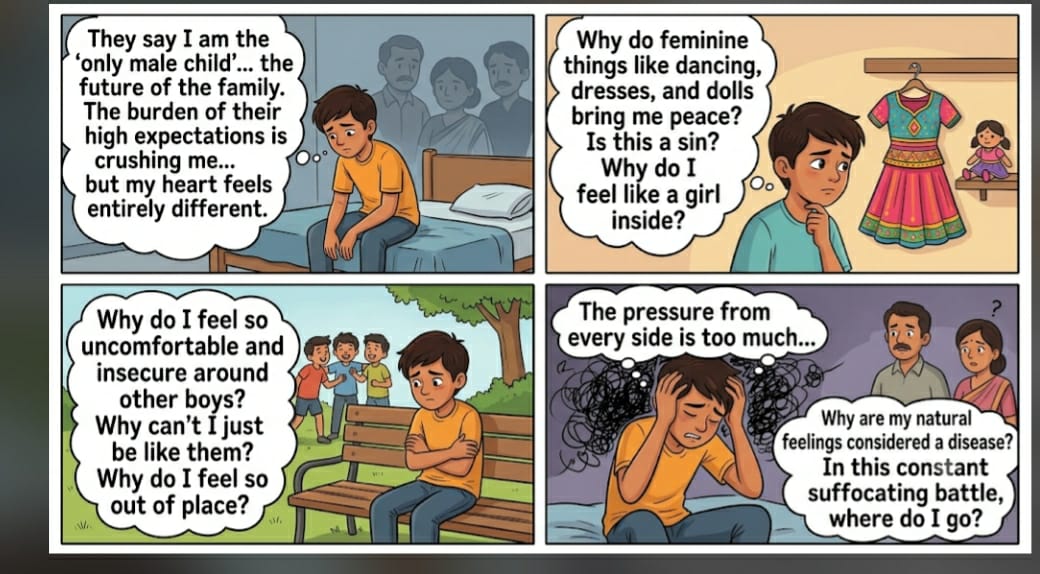
Tears streamed down my face. They were tears of relief and gratitude that this young person was receiving help and that there was renewed hope for him and his family. I could not help thinking about the immense pressure families endure when their children’s lives do not conform to society’s expectations.
But beneath my relief was also anger.
Why are we so quick to judge a child whose behaviour, appearance, or emotional world differs from what we consider normal? Why do we turn differences into reasons for ridicule, suspicion, or exclusion? And why must a young person struggle not only with personal distress but also with the fear of being rejected by the very people from whom he needs acceptance?
Society often speaks of protecting children, yet we frequently impose rigid ideas of masculinity and femininity upon them long before they have the language or confidence to understand themselves. We teach boys to suppress tears, discourage them from interests considered feminine, and expect them to fit predetermined roles. When they cannot—or simply do not wish to—conform, we risk making them feel that something is wrong with them.
The answer is not to label every difference as a disorder or to force a child into a socially acceptable mould. It is to listen without humiliation, seek professional help when distress arises, and create an environment in which children can speak honestly without fearing rejection.
As a journalist, I left this experience with a question that continues to trouble me: How many young people suffer silently because they fear that society’s verdict matters more than their right to be understood?
We cannot manufacture empathy overnight. But we can begin by questioning our assumptions, choosing our words with care, and remembering that a child’s dignity is not conditional upon conformity.
Sometimes, a small doll in a teenager’s hands tells us less about what is wrong with the child than about the rigid expectations of the world around him.
Perhaps the first step towards healing is not to ask a young person why he is different, but to ask ourselves whether we have made it safe for him to be who he is.
I still remember that little doll. And sometimes I wonder: Was the doll really so fragile, or have we built a society so rigid that even a child’s simplest expression of himself can become a reason for discomfort?
Perhaps the problem was never the doll. Perhaps it was the weight of the expectations surrounding it.
We often tell children to be strong, but we rarely ask whether the world around them has become too harsh. We expect them to withstand judgement, ridicule, and rejection, even when what they need most is understanding.
A society does not become stronger by forcing everyone into the same mould. Its real strength lies in making room for people who are different from us, without making them feel that they are somehow less worthy of love or respect.
That teenage boy did not need the world to understand every aspect of his life immediately. He deserved something much simpler: the freedom to exist without being judged, the reassurance that he was not wrong simply because he was different, and the opportunity to receive help when he needed it.
Because sometimes, the greatest change does not begin with a child learning to fit into society.
It begins when society learns to make space for the child. Kanch ki kanch ka saman mitti ki fitrat lohe ka Samaj aur kanch ki gudiya yah hatana hai ismein