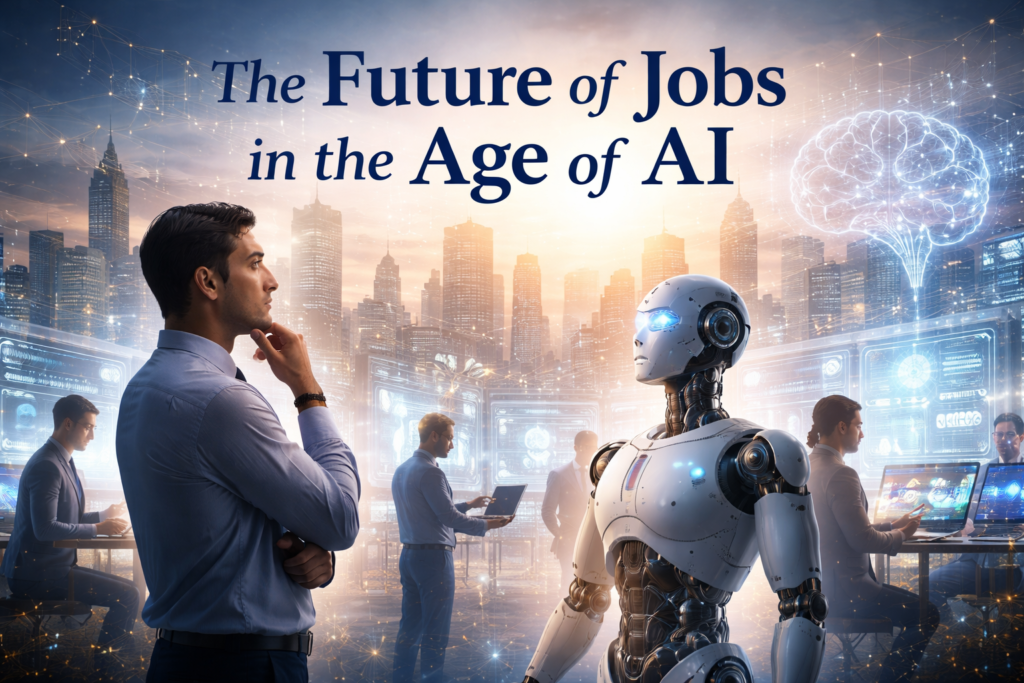
The Future of Jobs in the Age of AI: A Slow, Quiet Revolution
Some changes come slowly and quietly. They don’t arrive with noise—they slip gently into our lives, onto our screens, into our habits.
The AI impact on jobs is something like that—a slow, almost invisible revolution that is reshaping our work, our identity, and even the way we live.
What is the Future of Jobs with AI?
We often ask—what will happen to our jobs? But perhaps that’s not the right question.
The real question is—when work itself changes, what will we become?
Because work is not just a livelihood. It’s also a part of our identity, our routine, and sometimes, a reflection of our inner self.
How AI is Changing Work and Human Identity
And when machines begin to do tasks we once called “our own,” a quiet unease begins to settle within us.
AI is replacing repetitive work—tasks where creativity has little space. Data entry, call centers, and routine operations are slowly fading from the human world.
And maybe that’s not entirely wrong. Perhaps it’s time to move toward more meaningful, creative work.
AI and Employment Future: New Opportunities
But that’s only one side of the story.
The AI and employment future is also opening new doors—roles we hadn’t imagined before. Data scientists, prompt engineers, AI specialists—entirely new careers are emerging.
People are adapting and finding their place in this changing world.
The Unequal Impact of AI on Jobs
Still, this change is not the same for everyone.
A young person with internet access, a laptop, and learning resources can benefit from the future of jobs with AI.
But for someone limited to physical labor and basic opportunities, AI may feel less like an opportunity—and more like a barrier.
Is AI Bringing Us Closer or Further Apart?
This raises a deeper question—Is technology bringing us closer together, or pushing us further apart?
According to a report by the
World Economic Forum – Future of Jobs Report
, AI is expected to both create and displace millions of jobs globally, making adaptability a critical skill.
Human Skills in the Age of AI
Perhaps the most important skill today is not technical—it’s emotional.
Understanding, creativity, and empathy are becoming more valuable, because with every technological update, something deeply human risks being left behind.
Final Thoughts: Will AI Change Who We Are?
We are being taught to learn continuously, stay updated, and move forward.
But maybe we also need to pause—and ask what is getting lost in the process.
AI will change the way we work. That is almost certain.
But will it change who we are?
In the speed of machines, will something deeply human be left behind?
And in all this progress, will our own voice slowly fade away?